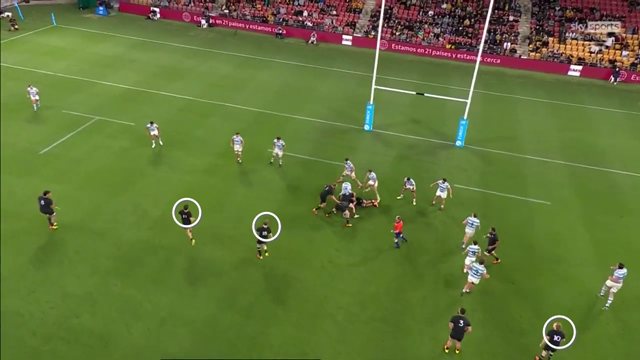
Attack, Attack and more Attack tracked some of the newer developments in the game at ruck and maul in the practice of the recent Nations Championship. The first three rounds of that competition provided a very tasty primo to the secondo course, a full-bore, seven-week tour of South Africa by the All Blacks which begins on 7 August with an opener against the Stormers in Cape Town.
It represents a return to old-style touring, or at least the closest you can get to it within the context of a busy global professional calendar. There will be very little fat on the bone of the eight-match tour, with four matches against South Africa’s ex-Super Rugby franchises combined with a four-Test series versus the world champion Springboks. The tour will be concentrated and it will be intense, right from the start.
The shared history between the two greatest rugby nations on planet rugby would be enough to attract engagement from dyed-in-the-wool supporters on both sides, and from coaches all over the world, whatever their national allegiance. What has piqued interest is the rapid development ‘back to the future’ under new All Blacks’ coach Dave Rennie. The Rennie era is fast coming to represent a boomerang back to the New Zealand values associated with the golden decade of 2008-2018.
An excerpt from a report by World Rugby consultant and ex-IRB referee Corris Thomas after the 2025 Rugby Championship illustrates just how far the ‘Razor’ Robertson era had drifted from the traditional mana of the All Blacks:
“The 33-point loss to South Africa [at the Cake-Tin in Wellington] was their heaviest-ever defeat. South Africa scored 36 unanswered points in the second half. The 43 points scored by South Africa were the most ever scored by an away team in New Zealand.
“In reaching second place, New Zealand brought an approach to the game that differed in several ways from that seen previously. That approach had resulted in tries being scored from all parts of the field and from the various sources of possession. Tries from inside their own half were not uncommon, as were tries from broken play, kicks by their opponents and tap penalties.
“This year’s TRC was very different.
New Zealand scored 81% of their tries from the set-pieces of lineout and scrums
The other three teams [Australia, Argentina and South Africa] averaged 52% from the same sources
New Zealand only scored two tries from turnover or open-field kicks, lowest of any team, and 11 less than South Africa
New Zealand scored 70% of their tries from possession gained inside their opponents’ 22m- line – the highest proportion of any team
New Zealand scored two tries originating from inside their own half – the lowest proportion of any team.”
Those statistics are startling in the context of New Zealand’s trend-setting innovations during the golden decade, and the profound influence of ‘the Professor’ Sir Wayne Smith, one of the pioneers of transition theory and the dynamic movement from defence to attack. In a mentoring session on The Rugby Site Counter Attack , he highlighted ‘the best chance of success. There is a <b>great attacking platform [to be had] off turnover and kick receipts. Counterattacks dominate the scoring in the modern game, and it’s a part of the game that needs to be coached.’</b>
‘Smithy’ would also talk extensively about the need to run the opposition off their feet and find new ways to cause fatigue in the opposition: ‘In years gone by the game always opened up in the last 20 minutes, and games were often won in the last 20 minutes.’ Only a couple of years ago, he was still banging the same drum via the need for fewer substitutions in the modern game: ‘What are our athletes going to look like? I think over time they’ll look at fewer substitutions. There’s talk in World Rugby about trying to create more fatigue. They’ve woken up to the fact we need to change.’
Under the auspices of Rennie and his selector-in-chief, and another Rugby Site founding father Sir Graham Henry, the changes already run far more than merely skin-deep. The attitude towards turnover ball has been transformed from the Razor era:
New Zealand try-scoring profile: Razor to Rennie
| Tournament | Tries from set-piece / % | Tries from turnover / % |
| TRC 2025 [6 games] | 19*/91% | 2/9% |
| Nations Champ 2026 [3 games] | 10/56% | 8/44% |
*Includes static starters like free-kicks and tap pens
Now let’s look at how the profile of the All Blacks has shifted in relation to their arch rivals the Springboks over the same two competitions:
All Blacks-Springbok play-style comparison TRC 2025
| Team | Average ball-in-play time [mins] | Active time-of-possession [mins] | Average Rucks per game | Average ruck-speed per game [seconds] | Average kicks per game |
| South Africa | 35’ | 18’ | 83 | 3.7 | 30 |
| New Zealand | 36’ | 17’ | 84 | 3.8 | 26 |
At the major southern hemisphere showcase nearly 12 months ago, there were no major differences between the way South Africa and New Zealand were approaching the task of winning Test matches, according to these Key Performance Indicators. The emphasis on the kicking game, the attitude to ruck-building and the aims in ball-in-play and active time-of-possession were all roughly the same.
Now look at the same stats for the two sides at the Nations Championship:
All Blacks-Springbok play-style comparison Nations Champ 2026
| Team | Average ball-in-play time [mins] | Active time-of-possession [mins] | Average Rucks per game | Average ruck-speed per game [seconds] | Average kicks per game |
| South Africa | 36’ | 18’ | 81 | 4.2 | 28 |
| New Zealand | 41’ | 24’ | 139 | 2.9 | 19 |
South Africa’s figures are all approximately equivalent to those they posted 12 months ago. The Springboks still kick the most of any team in top-tier competition and they do not prioritize ruck-speed consistently. <b>The averages for rucks built, and ball-in-play time remain the same. </b>
But the new sense of definition in the All Blacks’ game is spectacularly obvious. Instead of trying to combat the Boks on their own terms, suddenly the men in black are <b>averaging five minutes more ball-in-play time and six minutes more active time-of-possession, they are building 58 more rucks at an average speed 1.3 seconds quicker </b>than Rassie’s charges.
Summary
<b>New Zealand is kicking the ball away nine times less than South Africa</b>, and it is back to doing what it does best: <b>finding new ways to create fatigue in the opposition with ball in hand</b>, wearing them down in the last 20 minutes of the game. They will challenge Rassie’s renowned ‘bomb squad’ in the final quarter of each Test match. At last, the paying public in both countries will be able to enjoy the bright splashes of colour, and <b>the broad contrasts in playing style which have always made the ‘Greatest Rivalry’ in rugby so very special.</b>